

Run your best race

Fitness is only part of race day. RaceReady helps you prepare the energy, hydration and fueling around it.

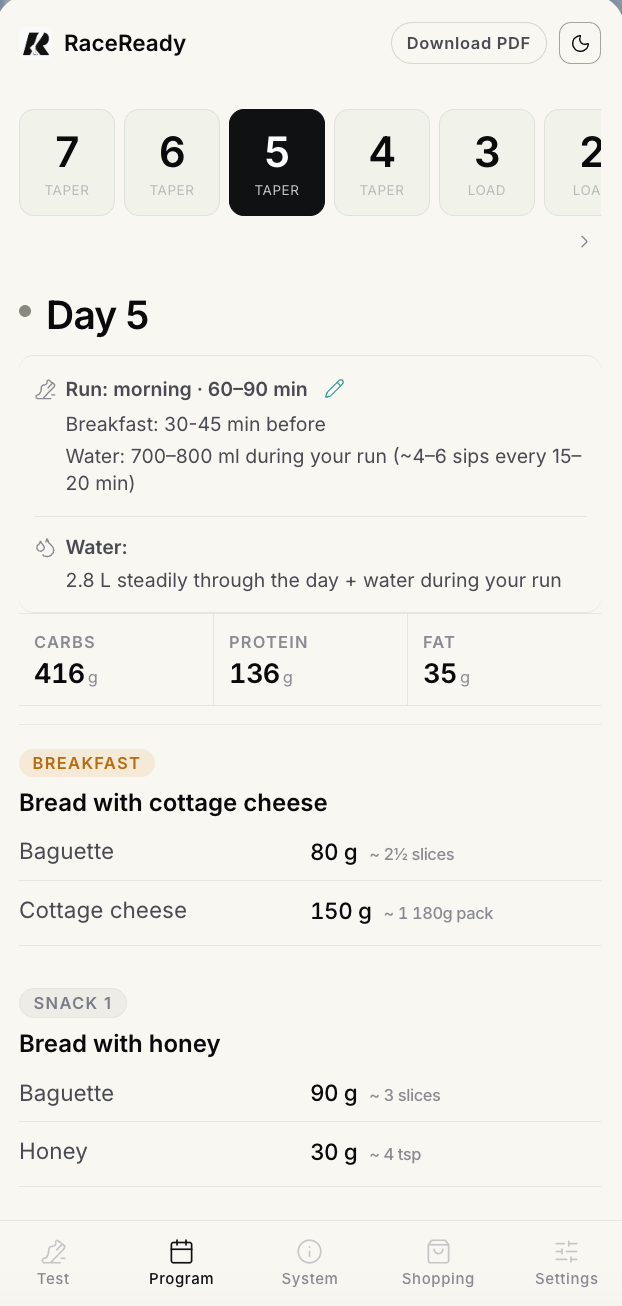
01 Run timing
02 Daily hydration
03 Day target
04 Meals
RaceReady Day 5 race-week product screen03 Day target01 Run timing02 Daily hydration04 Meals
WHY RACEREADY

RaceReady combines guidance from IOC* and ACSM**, validation by a sports nutritionist, and feedback from experienced runners.

* International Olympic Committee.** American College of Sports Medicine.

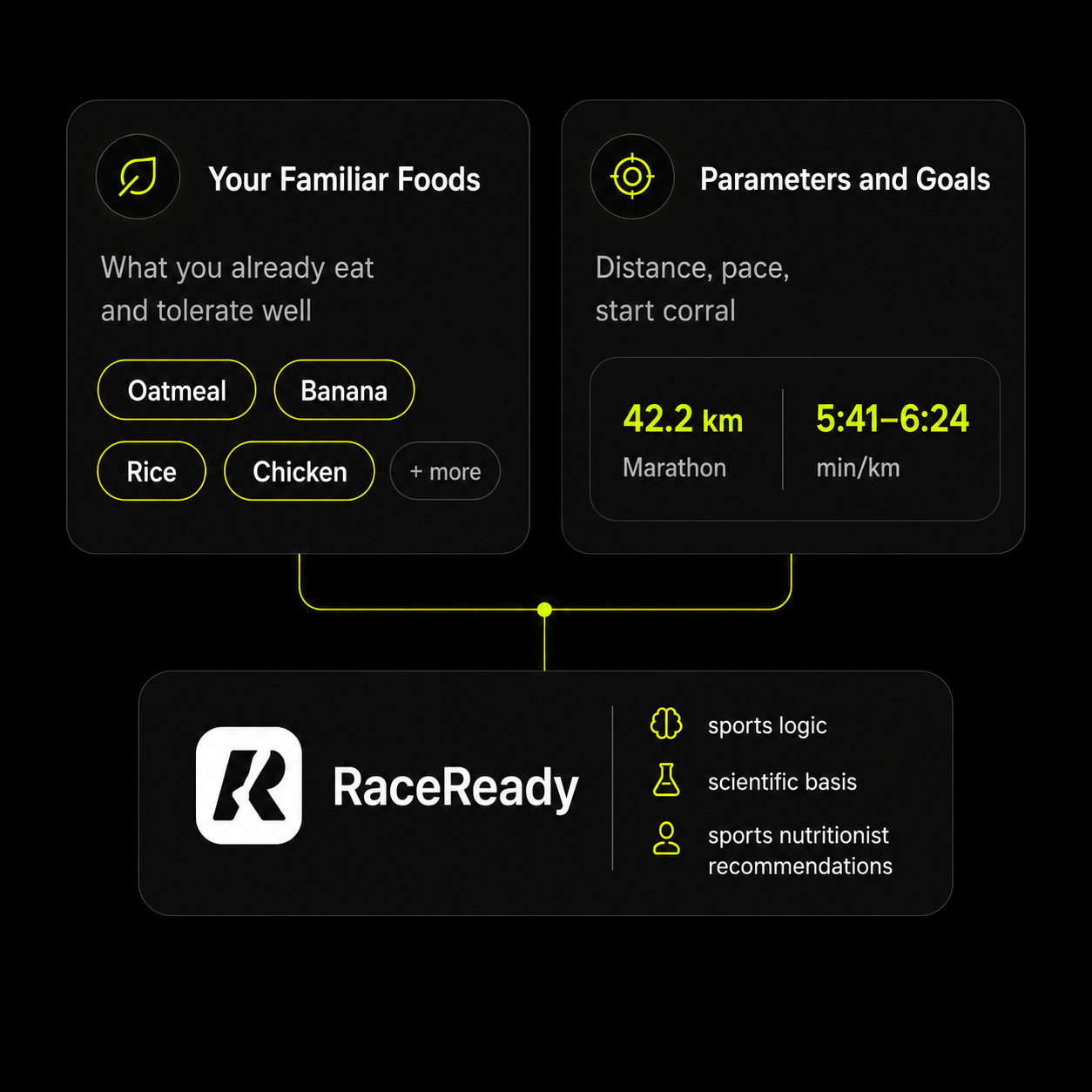
RaceReady onboarding methodology diagram

* International Olympic Committee.** American College of Sports Medicine.

RaceReady product screen 1RaceReady race-week day screenRaceReady product screen 3RaceReady product screen 4RaceReady product screen 5RaceReady product screen 6
YOUR SYSTEM

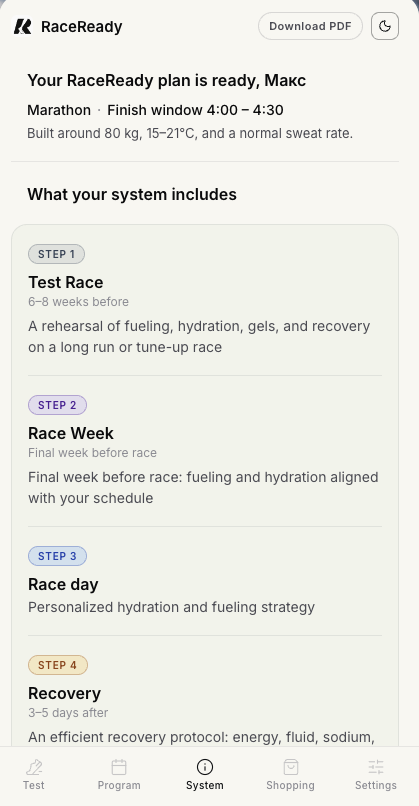
Comprehensive approach to support your race

Focused on the race stages that matter most

5–8 weeks before
TEST RACE

Rehearse before the main race

Final 7 days
RACE WEEK

Build up your energy stores to hit a start line at max

Start
RACE

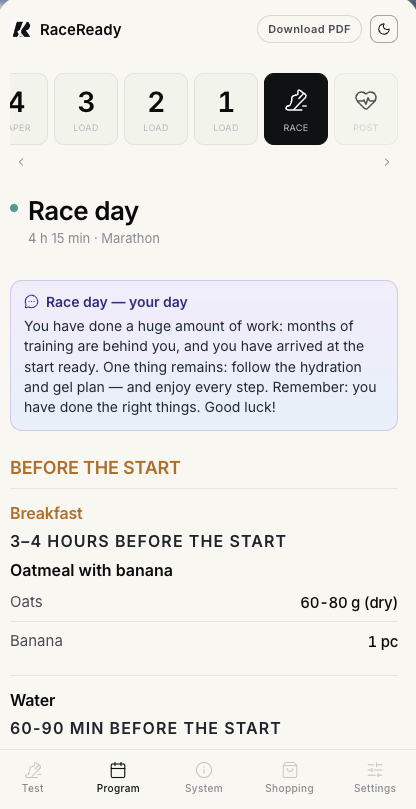
Follow your fueling and hydration plan

Next 2–3 days
RECOVERY

Thoughtful guidance for the following days

RUNNER FEEDBACK

What runners say after using RaceReady

THE DETAILS
What is RaceReady based on?

The underlying principles are not secret knowledge. RaceReady uses endurance-nutrition reference principles associated with the International Olympic Committee and the American College of Sports Medicine: carbohydrate availability, hydration and electrolyte strategy, race fueling, gut training and recovery.

The methodology, protocol logic and product flow were reviewed and validated by a sports nutritionist, then shaped further by feedback from experienced runners. The value is not a magic formula — it is turning public science into one personal, followable system around your race.

What does RaceReady actually give me?

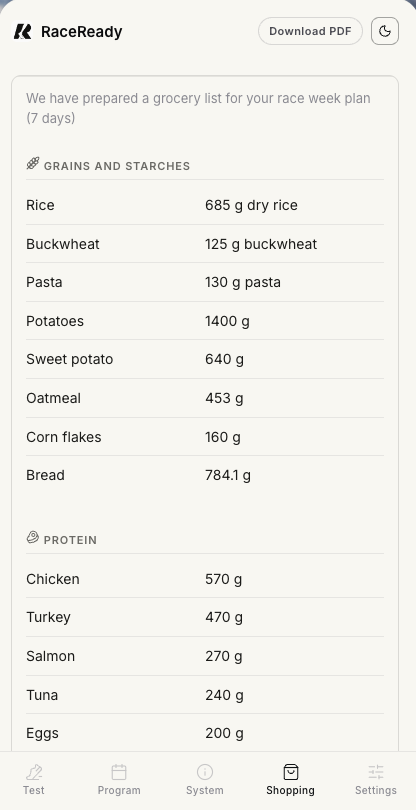
RaceReady gives you one connected preparation system: a final-week food plan, carbohydrate-loading targets, hydration guidance, race-day breakfast and fueling logic, a Test Race rehearsal, recovery guidance, a shopping list and a downloadable PDF.

It is built around the practical details that are easy to leave until too late: what you need to buy, what changes around training, what to prepare before race morning, and when to use fuel and fluids once the race has started.

How is my plan personalised?

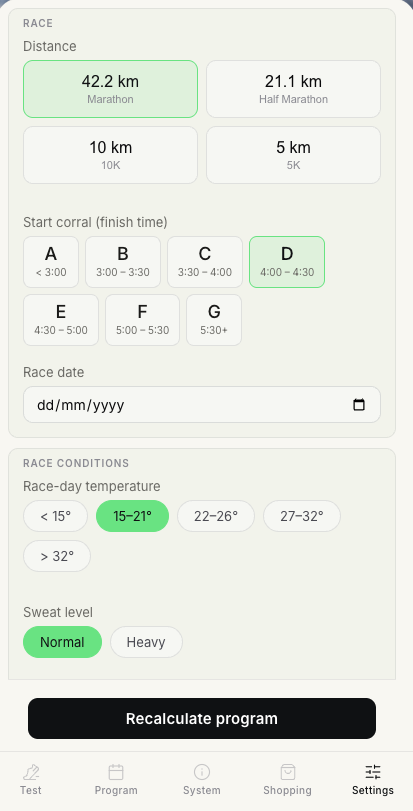
RaceReady starts with the inputs that genuinely change race preparation: your body weight, race distance, target intensity, how much you tend to sweat, familiar foods and how well your gut tolerates a higher carbohydrate intake.

Those inputs shape carbohydrate targets, hydration guidance, meal timing and race-day fueling. You can also adjust training timing when real life changes. The goal is not to make you track every gram like a professional athlete — it is to turn the right targets into a system you can actually follow.

What is a Test Race — and why does it matter?

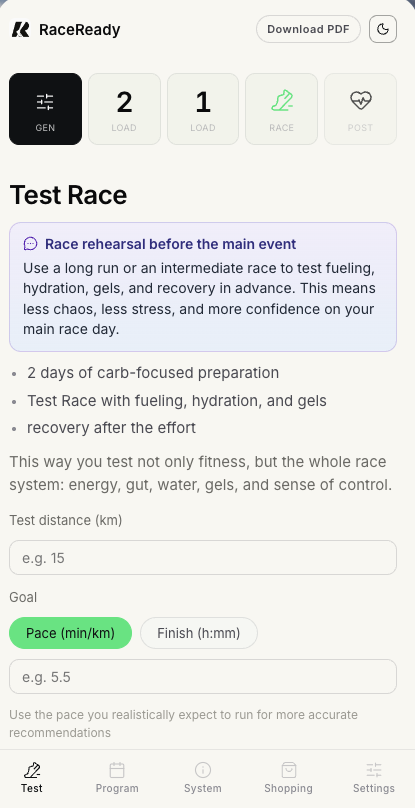
A Test Race turns a long run or tune-up race into a rehearsal of your main event. You test a short carb-focused preparation, breakfast, fluids, gel timing, carbohydrate amounts and what your stomach actually tolerates once the pace rises.

This is often called gut training. Your muscles may be ready to use more carbohydrate than your gut is used to receiving. A Test Race lets you test and train that process before race day, so your attention stays on pace and execution rather than discomfort or improvisation.

Why do carbs and hydration need to be planned together?

Think of fitness as the engine. Carbohydrates are the fuel in the tank: they support glycogen stores before the race and blood-glucose availability while you are running. Hydration and electrolytes are the operating conditions that help the system keep working as sweat loss and heat strain rise.

A strong engine cannot deliver its best if either part breaks down. RaceReady plans fuel and fluids together, based on race demand, your body inputs, sweating, timing and what your gut can tolerate — not as two separate pieces of generic advice.

Why does hydration affect more than thirst?

Fluid loss can increase cardiovascular and heat strain, so the same pace starts to cost more. Concentration can drop at the point when you still need to make good decisions about pacing, gels and water stations.

Some runners describe this late-race feeling as central fatigue: the legs may still move, but sustaining the effort feels mentally much harder. It is not caused by hydration alone, but fluid loss, heat and low carbohydrate availability can all add stress to the system. RaceReady helps you reduce those avoidable variables before the race becomes demanding.

Can I use familiar food and still fuel properly?

Yes. The final week is not the time to introduce a strict diet or foods your stomach has never met before. RaceReady starts from familiar food and adjusts portions, timing and combinations around the demands of your race.

Some final-loading meals may become simpler and lower in fibre on purpose: the aim is to raise carbohydrate availability while reducing unnecessary gastrointestinal load. Race-day fuel is different — gels, drinks or other portable carbohydrate sources may be needed during a long event — but these are tested in the Test Race rather than discovered on race morning.

Do I need to change my diet for months?

No. RaceReady is not a restrictive diet for your whole training cycle. The main preparation happens in the final seven days, when carbohydrate loading, hydration and familiar food need to work together — then on race day and during the first recovery days after the finish.

A Test Race is separate. You can use it before the main event, whenever a long run or tune-up race makes sense. It lets you rehearse breakfast, fluids, gel timing and recovery before the marathon becomes the experiment.

What happens after the finish?

Recovery is not an afterthought. A long race uses carbohydrate stores, fluids and electrolytes, and creates a level of muscular stress that does not disappear when you cross the line.

RaceReady gives you a simple sequence for the first two to three days: what to prioritise first, how to restore carbohydrate and protein intake, how to rehydrate and how to return to normal food without overcomplicating it. The system closes the loop: prepare, execute, recover.

Who is RaceReady for?

RaceReady is for runners who want the non-training part of an important race to be as deliberate as their training. It connects the final week, hydration, race fueling, a Test Race when useful, race-day execution and recovery into one system.

The system is the same for everyone; the job is different. For a less experienced runner, it reduces avoidable unknowns around fuel, fluids, gut comfort and timing before a first half or full marathon. For an experienced runner, those same inputs become controllable performance levers: a steadier pace, fewer late-race surprises and a better chance of delivering the time their fitness allows.